Semantic Annotation for the Ancient World Conference 2026
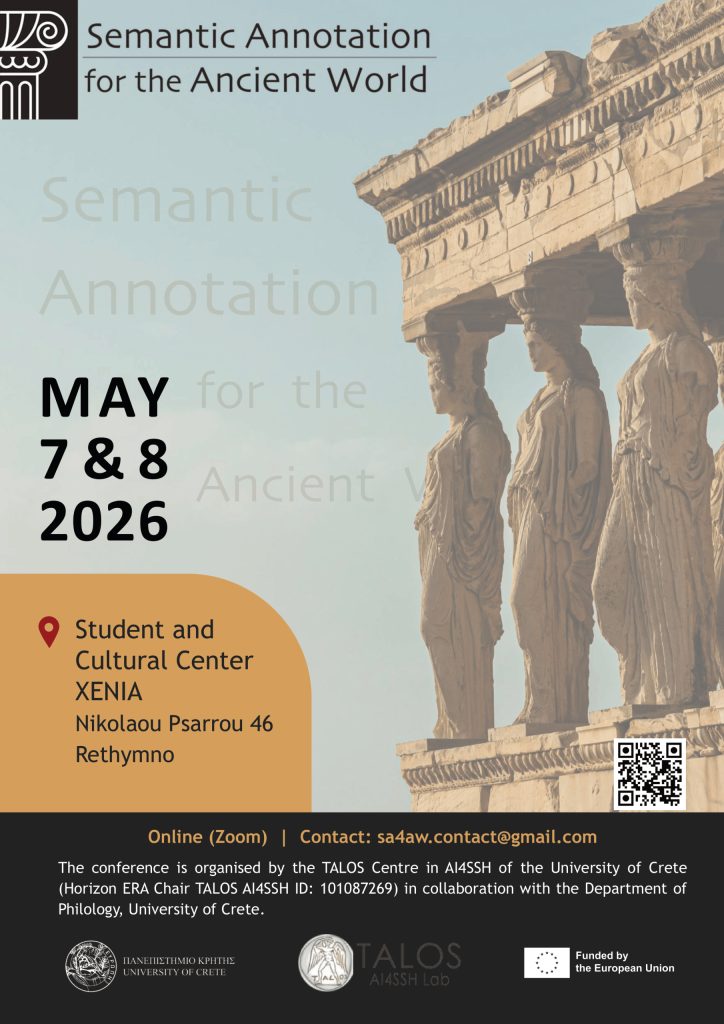
7-8 May, 2026
Student and Cultural Center XENIA, Nikolaou Psarrou 46, GR74133, Rethymno, Crete
See the location on Google Maps →
Participation in SA4AW is free of charge!
On-site & online (via Zoom) participation. Register for online participation.
Submit abstracts (750-1000 words) at the EasyChair by February 15th 2026

Conference Resources
The second Semantic Annotation for the Ancient World (SA4AW) conference examines the role of semantic annotation in dialogue with hybrid AI approaches, large language models (LLMs), deep learning, and knowledge graphs in the study of the ancient world and cultural heritage. Semantic annotation—whether manual, automated, or human-in-the-loop—enables the identification and linking of concepts, entities, and relationships, transforming raw textual and visual data into structured, interoperable knowledge. At a moment when LLMs can generate fluent interpretations but require grounding in domain-specific context, semantic annotation and knowledge graphs provide essential transparency, precision, and reusability. We welcome contributions that showcase methods, tools, case studies, theoretical reflections, and cross-disciplinary collaborations. In line with FAIR and Linked Open Data principles, the conference encourages open and accessible research practices.
PROPOSALS’ THEMES
We encourage proposals on the following themes
✓
Ontology-driven semantic annotation
✓
Standardisation
✓
Multilingual annotation practices
✓
Automatic and semi-automatic annotation
✓
Annotation of ancient geography
✓
FAIR/LOD data
✓
Semantic Web
✓
NER for ancient Greek/Latin
✓
RDF-based digital editions
✓
Methods, tools, and platforms
CONFERENCE SCOPE
INVITATION
We invite proposals from researchers at all career stages, working in the topic areas of the conference.
PRESENTATION
Paper presentations will be 20 minutes long, with extra time for questions and discussion.
ABSTRACT
Please submit an abstract of max. 1,000 words (bibliography excluded, free format).
PUBLICATION
A longer version of accepted papers will be published in an edited volume after the conference. More details about the edited volume are forthcoming.
REVIEW
Submissions will be reviewed via double-blind peer review through EasyChair.
LANGUAGE
The working language of the conference is English.

TRAVEL INFORMATION
Rethymno is equidistant between two international airports, Chania (CHQ) and Heraklion (HER).
Journey time from either airport to Rethymno is approximately an hour via bus. From CHQ, the KTEL bus service will bring you directly to Rethymno.
From HER, there is a smaller local bus which will bring you to the central Heraklion bus station where you can catch a KTEL bus to Rethymno.
For information on the KTEL bus schedule, visit this site.
The University of Crete is located in Rethymno, Crete.
Rethymno sees a lot of tourists in the summer months, so there are plenty of options for accommodation.
We recommend Jo-An Palace, Achillion Palace, Theartemis Palace, Liberty Hotel, or Olympic Palladium, which are all centrally located in Rethymno.
“XENIA”, the Student and Cultural Center at the University of Crete, is located in downtown Rethymno at Nikolaou Psarrou 46. The venue is walking distance from hotels in the city center. See the location on GoogleMaps →
For participants staying outside of the center of Rethymno, the University bus runs through the city center every twenty minutes. Tickets for the bus can be purchased at a variety of kiosks throughout the city, and cost 1,40 euro (0,70 for students). Look for the bus labelled University/Πανεπιστήμιο.
For more about Rethymno and the University of Crete, you can visit the following sites:
PROGRAM COMMITTEE
Elton Barker
The Open University
Monica Berti
Universität Leipzig – Institut für Informatik
Antonis Bikakis
University College London
Nelson Henrique Da Silva Ferreira
University of Coimbra
Eleni Gkadolou
British School at Athens
Leif Isaksen
University of Exeter
Alek Keersmaekers
KU Leuven
Maxim Kupreyev
OPERAS RI
Terhi Nurmikko-Fuller
Australian National University
Eleonora Litta
Università Cattolica del Sacro Cuore
Delfim Leão
University of Coimbra
Anna Novokhatko
Albert-Ludwigs-Universität Freiburg
Annie Lamar
UC Santa Barbara
Chiara Palladino
Durham University
Silvia Piccini
Istituto di Linguistica Computazionale, Pisa
Christophe Roche
University of Savoie
ORGANIZERS
Maria Papadopoulou
Assistant Professor of Digital Humanities and Classics, TALOS AI4SSH & Department of Philology, University of Crete

Rachel Milio
Ph.D. candidate, TALOS AI4SSH & Department of Philology, University of Crete
PROGRAM TIMELINE
November 22nd,
2025
–
Call for Papers
February 15th
2026
–
Deadline for Submission of Abstracts
March 15th
2026
–
Notification of Acceptance to Authors
March 25th
2026
–
Deadline of Confirmation of Participation by Accepted Author
April 15th
2026
–
Submission of Camera-Ready Abstract
May 7th-8th
2026
–
Conference Dates
December 1st
2026
–
Submission of Camera-Ready Version of Final Paper
February 1st
2027
–
End of Peer Review Period
March 15th
2027
–
Deadline for Final Revisions for Accepted Articles
July
2027
–