Semantic Annotation for the Ancient World Conference 2025
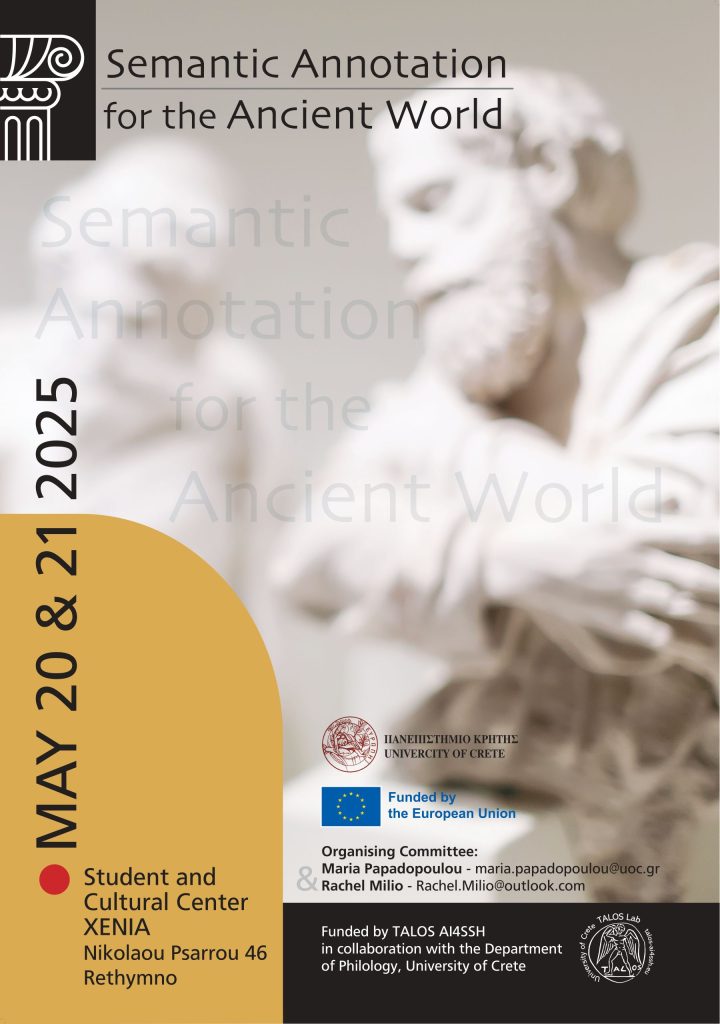
May 20 & 21, 2025
Student and Cultural Center XENIA, Nikolaou Psarrou 46, Rethymno, Crete
See the location on Google Maps →
Participation in SA4AW is free of charge!
On-site & online (via Zoom) participation. Register for online participation.
Submit abstracts (750-1000 words) at the EasyChair by February 15th 2025

Conference Resources
This conference will explore the contribution of semantic annotation, along with that of hybrid AI, deep learning, and knowledge graphs to ancient world studies. Semantic annotation is the process of tagging or (manually or automatically) labelling pieces of content—such as words, phrases, or objects in texts or images—with meaningful metadata to provide context and clarify meaning. Semantic annotation allows machines to process the meaning and relationships of content within a dataset, transforming raw data into structured knowledge. For example, a machine can recognize that “Athens” is a city, distinguish it from the other cities with the same name, and link it to related concepts, which improves ability to perform tasks like searching, or making inferences. By tagging concepts, entities, and relations, semantic annotation enables machines to interpret and process data more accurately, connecting data points across software, allowing for better searchability, advanced queries and further reuse via natural language processing and machine learning.
Through this conference, we hope to foster collaboration and intellectual exchange amongst digital scholars of the ancient world. According to the principles of FAIR and Linked Open Data, we strive to promote openness and accessibility in all of the workflows and methods presented at the conference.
PROPOSALS’ THEMES
We encourage proposals on the following themes
✓
Ontology-driven semantic annotation
✓
Standardisation
✓
Multilingual annotation practices
✓
Automatic and semi-automatic annotation
✓
Annotation of ancient geography
✓
FAIR/LOD data
✓
Semantic Web
✓
NER for ancient Greek/Latin
✓
RDF-based digital editions
✓
Methods, tools, and platforms
CONFERENCE SCOPE
INVITATION
We invite proposals from researchers at all career stages, working in the topic areas of the conference.
PRESENTATION
Paper presentations will be 20 minutes long, with extra time for questions and discussion.
ABSTRACT
Please submit an abstract of max. 1,000 words (bibliography excluded, free format).
PUBLICATION
A longer version of accepted papers will be published in an edited volume after the conference. More details about the edited volume are forthcoming.
REVIEW
Submissions will be reviewed via double-blind peer review through EasyChair.
LANGUAGE
The working language of the conference is English.
PROGRAM COMMITTEE
Elton Barker
The Open University
Monica Berti
Universität Leipzig – Institut für Informatik
Antonis Bikakis
University College London
Dimitrios Bilianos
University of Athens
Margherita Fantoli
KU Leuven
Leif Isaksen
University of Exeter
Diane Jakacki
Bucknell University
Olha Kanishcheva
National Technical University
“Kharkov Polytechnic Institute”
Nikos Litinas
University of Crete
Hiu Liu
Nanjing University of Aeronautics
and Astronautics
Chiara Palladino
Furman University
Eirene Seiradaki
Director of Research Partnerships,
RBC Borealis
Wei Tong
Peking University
Silvia Piccini
Istituto di Linguistica Computazionale, Pisa
Melina Tamiolaki
University of Crete
Christophe Roche
University of Savoie
ORGANIZERS
Maria Papadopoulou
Assistant Professor of Digital Humanities and Classics, TALOS AI4SSH & Department of Philology, University of Crete

Rachel Milio
Ph.D. candidate, TALOS AI4SSH & Department of Philology, University of Crete
PROGRAM TIMELINE
November 22nd
2024
–
Call for Papers
February 15th
2025
–
Deadline for Submission of Abstracts
March 13th
2025
–
Notification of Acceptance to Authors
March 20th
2025
–
Deadline for Confirmation of Participation for Authors
May 20th-21st
2025
–
Conference Dates
December 1st
2025
–
Submission of Final Paper Version
July
2026
–